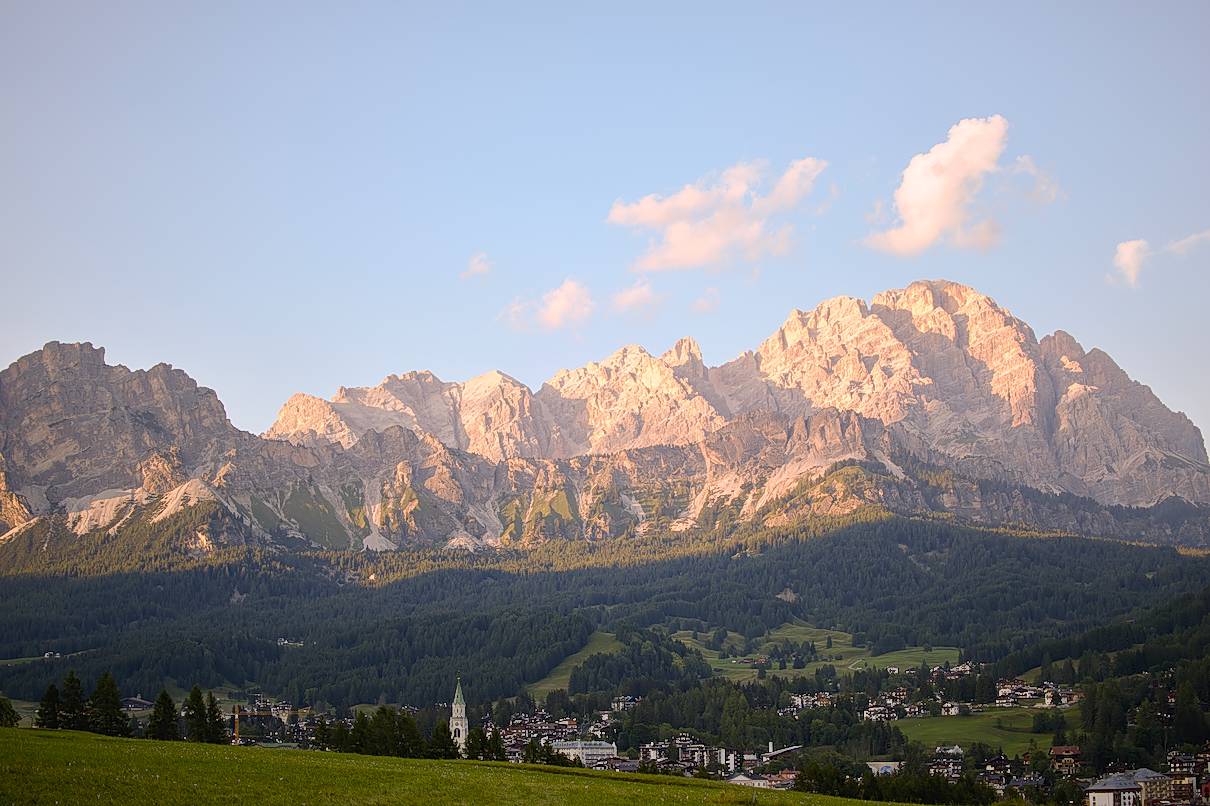
When I decided that what I had written was ready to be published, I instinctively reached for my work notebook and just read through those lines that came to light during one sunny 4 September 2026 on top of the Mount Tofàna de Ròzes at 3225 meters above sea level. My opinion, thinking about it with a clear mind, is that I was finding inspiration in seeing the Sass Maor rising up from the distance and imagining the near Primiero Valley where, among many others, I first asked myself the question: “Is it stone or is it cloud?” (Sono pietre o sono nuvole?). I will leave the well-placed citation (just to put it mildly) where it is. Good luck finding it. It is a symbol of the refinement with which our neighbours know to cultivate that breath of mystery that only dolomitic land exudes.
This question, I mean the one about stones and clouds, kept returning since 2022, while exactly this year it became stronger, louder, and heavier. Maybe it was seeing the film The Eight Mountains, or hearing it being read by another voice, exactly on a day where stone and cloud were at least partially overlapping.
Sono vere, oppure è un sogno? (Is it truth or is it dream?) is a verse adaptation that was made by the composer and cellist Giovanni Sollima. His work is based on Ma le dolomiti cosa sono? (What are the Dolomites, then?) by Dino Buzzati (1956) and the textual form of that poem is the source from which I wrote what I am about to tell you. Its very concept is fascinating because it's highly varied and interdisciplinary. I recommend you to listen to the composition “Sono vere oppure è un sogno?”, indeed by Giovanni Sollima.
So, on that 4th September, I felt like I wanted to open the door, also for those who do not know their way around the Italian language, to be confronted with such questions that Buzzati postulates. Therefore, I quickly transcribed my thoughts into German, well aware that I would need a proper desk to translate my stream of consciousness in a structured way into German and English. My texts are meant to transpose the original and be an autonomous work: at the classical lyceum I learned through Baudelaire how complex and difficult it is to translate poems.
Anyway, the final form in German came to light on 11th October, while I was having a training session at Innsbruck’s Climbing Center. On that occasion, I asked some native speakers to tell me their opinions about the choices that I had operated and, in order to get to those suggestions as well as pieces of advice, described a scene in which the author is observing the Dolomites through binoculars and perceives the aura of mystery that permeates them. I think that this resulted in useful suggestions and provided the final polish to my German text on one hand, set a clearer path for the English version on the other. It goes without saying, then, that also Is it truth or is it dream? is a translation, but does not seek to position itself in the exact moment when the original was conceived. That is 1956 or 2002, depending on whether one prefers Buzzati's or Sollima's as the original version.
Before I let you move on to reading further, I would like to underline the importance of questioning and posing yourself questions. My recent work experience in tourism and at the global scale of the Ampezzano Valley and surroundings was the very last missing bit that convinced me about the convenience to create something which had not existed before.
Oh yes, because the products of my translation convey a message to two linguistic spheres that now obtain for the first time this exact access to the arguments expressed in Is It Truth or Is It Dream?
These two texts that I composed lead to two new identities that are enriching the extremely vast cultural heritage of the English and the German domains. The verses themselves also summarise the story of a territory, like the Dolomites, that preserves an immense historical, social, and cultural wealth.
Let us just think about the “Dolasilla” or “Val de Fànes” legends - and I will repeat Val de Fànes, because in the Dolomites one speaks and writes in Ladin and the toponymy of places like Cortina d'Ampezzo was altered by translating centuries-old names in a deliberate way. Another chapter that in my opinion receives a proper summary is the first World War. Just in one verse, “Il pallore dei morti” – “Pale dead bodies”: the Great War had indeed a severe impact on the Dolomites. With that said, it was not my intention at all to go with those texts beyond their actual meanings. I instead tried to remain as faithful as possible, knowing well what I learned from all seminars about Umberto Eco. Still, death is a theme that recurs in Buzzati's works, but also took place on the Pale Mountains in one of the darkest times of human history.
And then these questions: “Is it stone or is it cloud?”, “Is it truth or is it dream?”
Those are perfectly legitimate questions that, as an Ampezzano local, I would like to hear asked more often, near and far, in the north like in the south. Considerably and most notably to the people of Anpezo. This is another story; let me know if you want me to tell you more about it. Tell me also what you think about this set of reflections, because I will be very keen to read what you have to say.
I recommend you now – and we are coming to a close – something that's dear to my heart, as a Ladin and Ampezzano person who was born and raised amid these legendary places:
In the Dolomites, ask yourself questions. Do not come to search for answers.
The Dolomites. Is it stone or is it cloud? Is it truth or is it dream?
Is it stone or is it cloud?
Is it truth or is it dream?
Peak to peak,
rising tension,
uneven fields of verticality, as ice seals their crevices.
Shades draw into abysses,
meet fumed, glassy phantoms of limestone,
caves to gnomes,
warriors,
monks,
virgins.
Is it stone or is it cloud?
Is it truth or is it dream?
Seen from the valley bottom,
what colour becomes?
White,
grey,
pearl,
ash,
silver rays,
pulsing red roses,
pale dead bodies.
Is it stone or is it cloud?
Is it truth or is it dream?
-Translated into English by Matteo Menardi – matteomenardimenego.com.
All rights reserved. Any publication or republication requires Matteo Menardi’s written consent.
This poem is an English translation of Giovanni Sollima’s verse adaptation of Dino Buzzati’s 1956 text Ma le Dolomiti cosa sono? (“What are the Dolomites, then?”). The original Italian text is available online in the Italian Alpine Club (CAI) archive for Musical Heritage of the Alpine Culture, by kind permission of Almerina Buzzati.


